

Penalty kicks are always dramatic affairs in a football match, but when it comes to the penalty shootout in a tournament such as the FIFA World Cup with the hopes and dreams of nations hanging on a single kick of the ball, then the drama is ratcheted up 10X. But why do so many players make a dog’s breakfast of their spot kick attempts, asks Simon Lewis.
According to sport psychologist Dr Paul McCarthy, in professional football around 85% of spot kicks are converted during regulation play. Get to extra time and that number drops to 75% as the pressure on the kickers mounts. That’s one in four kicks missed!
The best penalty takers choose their spot to aim for before they run up… they reach the ball, kick with conviction, and it usually hits the back of the net. Modern players have started messing with the formula and they broke the blueprint. Some stand next to the ball and kick from a standing position, giving the keeper less of a clue which direction the kick is heading, but most now use a stuttering run-up to try and leave the keeper guessing right up to the last minute. However, with the kicker also having to adjust at the last moment it raises the margin for error to either kick too close to the keeper or to kick wide of the goal.
The Panenka kick straight down the middle is so cool but the Fool Factor is super high. Kickers use the Panenka anticipating that the keeper will dive to the left or right, leaving the middle of the goal unguarded. The theory is great, but rather don’t go there. Even though it’s so damn cool. Your best chance of scoring is hitting to the left or the right of the keeper… but which way? There are a few factors to consider. Firstly, are you left-footed or right-footed… and is the keeper left handed or right handed? Yes, these both make a difference!
Go around the bend
A right-footer kicking the ball from the penalty spot will have a natural curve off his boot that will see the ball curl slightly from his right side towards his left. A kick aimed towards the left side of the goal will curve slightly AWAY from the goal. However, if the right-footed kicker kicks towards the right post then the natural curve of the ball will bring the ball back in towards the right post. They could aim to kick the ball at the right post and, in theory, the ball’s natural curve would curl it in enough to slip inside the post and into the back of the net. GOAL! It’s almost as if the ball is curling around the keeper.
A helping hand
A goalkeeper’s dominant hand is naturally going to be stronger at reaching, stopping or deflecting a penalty kick. Maybe not an enormous difference, but there will be a difference, and in a penalty shootout small differences can have a huge impact. Knowing the keeper’s dominant hand can give the kicker an added advantage.
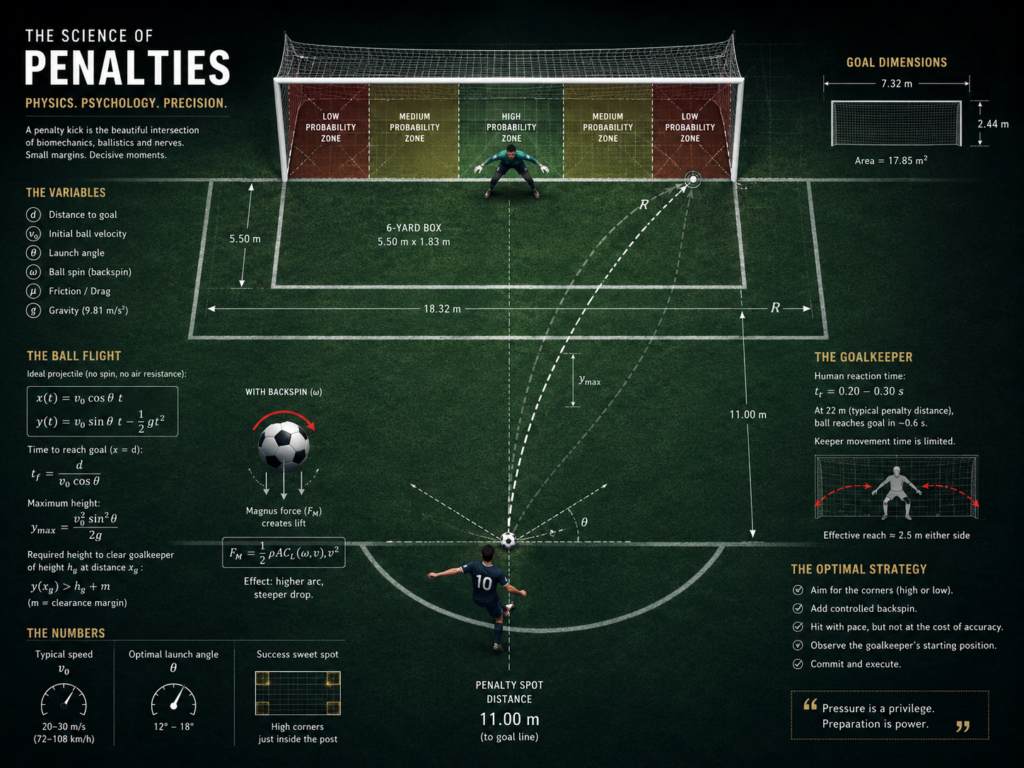
For some strange reason most penalty kicks are aimed at waist height or below but that doesn’t make sense… because of gravity. If the kicker aims their shot at chest high or above (and towards one of the top corners) then, when the keeper dives up to their left or right to attempt to save the kick, their body will pretty soon start falling towards the ground. This is a principle called gravity. Diving to the bottom corners is easier for keepers as they effectively allow gravity to help pull them towards the corner. Diving up towards the top corner will cause the keeper’s flight plan to arc downwards after the initial launch into the air, leaving an area above their gloves that they simply cannot reach.
That makes the top corner without doubt the area where you should aim your penalty kick, with the added benefit that you don’t have to kick it as hard in order to beat the diving keeper. You can rely more on just timing the ball sweetly rather than trying to blast it past the keeper, and that should ensure your kick is delivered with greater accuracy. It also doesn’t have to be right into the top corner as there is a far larger safe area to aim for in the top corners compared to if you are kicking towards one of the bottom corners.
Deny the keeper the upper hand
If you factor in the keeper’s strongest hand and kick to the side of the goal that will result in their strong hand being ‘under’ their body (ie closer to the ground) then as they are drawn to the ground by gravity the hand they will be waving towards the ball will be their weaker hand. Combine their body falling towards the ground with their weaker hand flapping at a ball rising above them and it should be crystal clear that this is the way to kick a penalty to win the World Cup (or to keep your side alive in a penalty shootout).
Now all you have to do is get your team into the final and force your opponents through 120 minutes and into the shootout. Simple. There is just one problem, though: if everyone followed this most sensible playbook we might never see a missed penalty ever again!!
Simon Lewis is the Editor of The Ball online sports magazine and the former features writer for SA Sports Illustrated.

